One source of truth
for your technology.
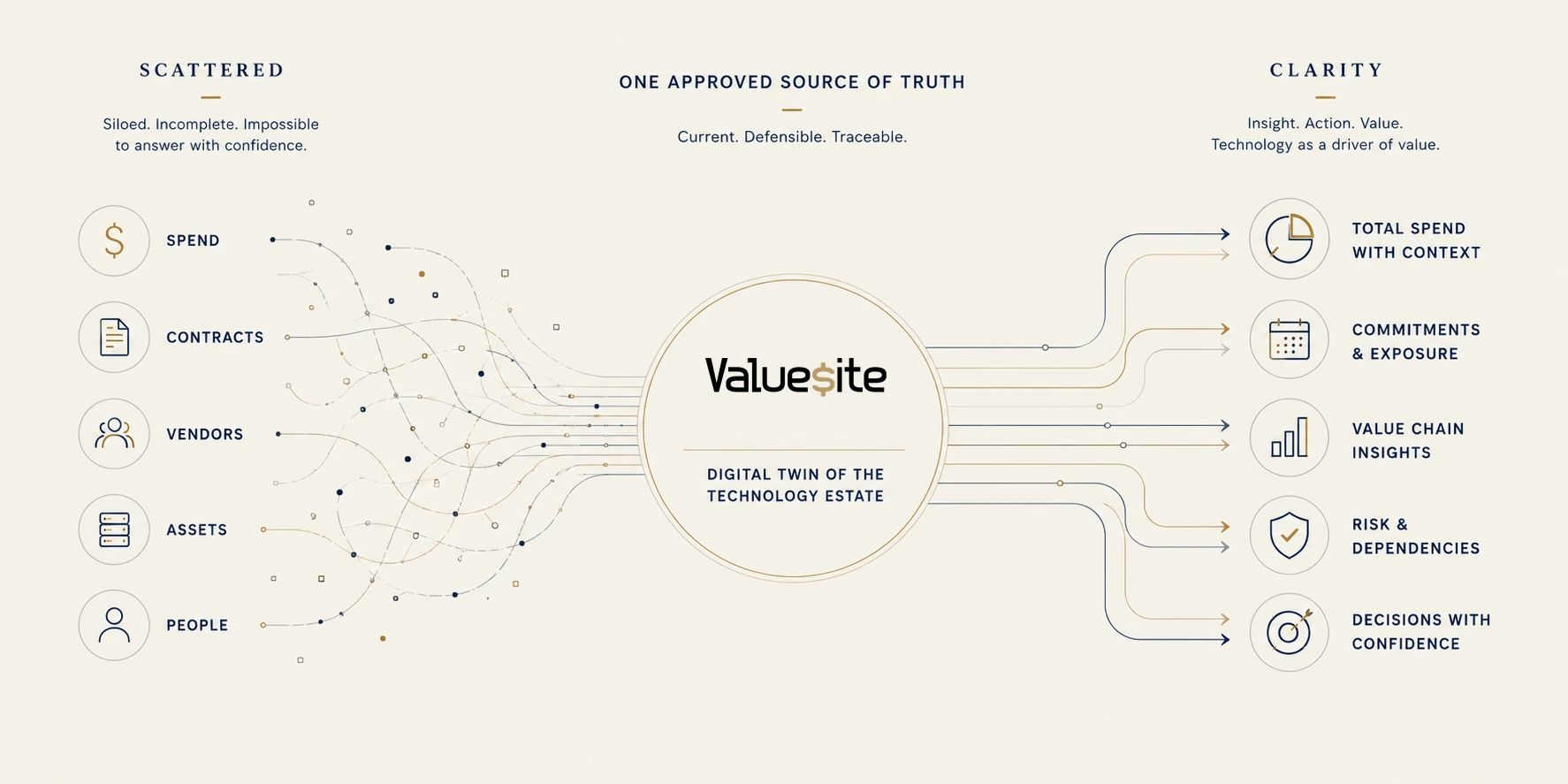
ValueSite is a digital twin of the technology estate: one approved source of truth for all technology spend, and the contracts, vendors, assets, and resources behind it. Every number is traced to its source and rated for confidence, so leadership can move the discussion from cost to value.
The question every leadership team asks, and few answer with confidence
True technology spend is often not visible. It sits across IT, marketing, sales, operations, and business-unit budgets, while leaders see only the IT budget: a partial number, and a poor basis for benchmarks, because every company draws the IT boundary differently. A partial number that looks high only invites a cut. The problem rarely looks like a visibility problem; it shows up as duplicate systems, budget surprises, unclear decision ownership, infrastructure risk, and a sense that IT costs too much.
A digital twin of your technology estate
These are the questions every leadership team should be asking. ValueSite answers them from one source of truth, and every number carries a consistent set of attributes: value, comparator, status, confidence rating, drill-through, and source. Status and confidence always travel together, so when a number is challenged, you go straight to the evidence.
What do we spend?
Total technology spend wherever it lives, including what hides in marketing, sales, operations, and business-unit budgets, not just the IT cost center.
Is it earning?
Whether that spend produces revenue and service, or merely keeps the lights on. Attributed, not assumed.
What are we committed to?
What renews, what’s locked, what you can exit, and what falls due when, so a renewal or change-of-control fee never arrives unannounced.
What if we change it?
What breaks, and what it costs, if you consolidate, carve out, or replace. Modeled before you commit.
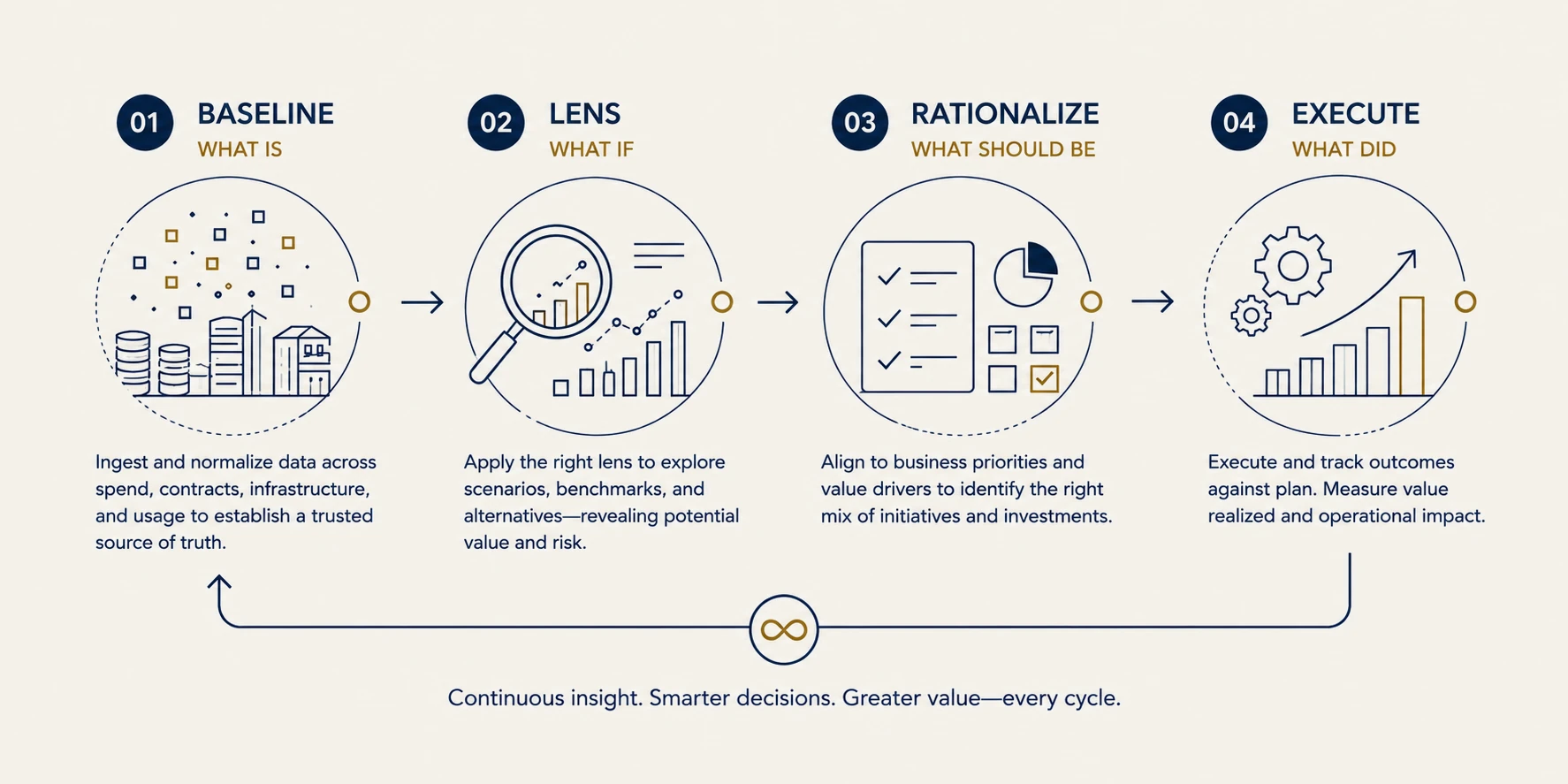
A continuous loop, not a snapshot
ValueSite is an approach supported by a platform, and the diagnostic is usually where it starts: a fast, evidence-based answer to the core questions, valuable on its own. The approach keeps it current through Baseline, Lens, Rationalize, and Execute, then back to Baseline. An investor may start with a diagnostic at diligence and carry it through the hold; an operator runs it continuously.
One source of truth, a view for every owner
The same Baseline serves every audience, with a view suited to each: run-rate and spend intensity for the CFO, spend and risk on the value chain for the CEO and the board, and the thesis lens for investors. Every view is a cut of one source of truth, so they always reconcile to the same total.
Private equity & M&A
Accelerate technology diligence, tag each deal to its investment thesis, surface separation and commitment exposure before close, and carry the same picture from screening through the hold to exit.
Leadership teams
Take ownership of every technology dollar: evidence for CFO and board discussions, and renewals and risk managed ahead of time. Ownership is accountability, not control: most budgets stay where they are, and nothing has to report to IT.
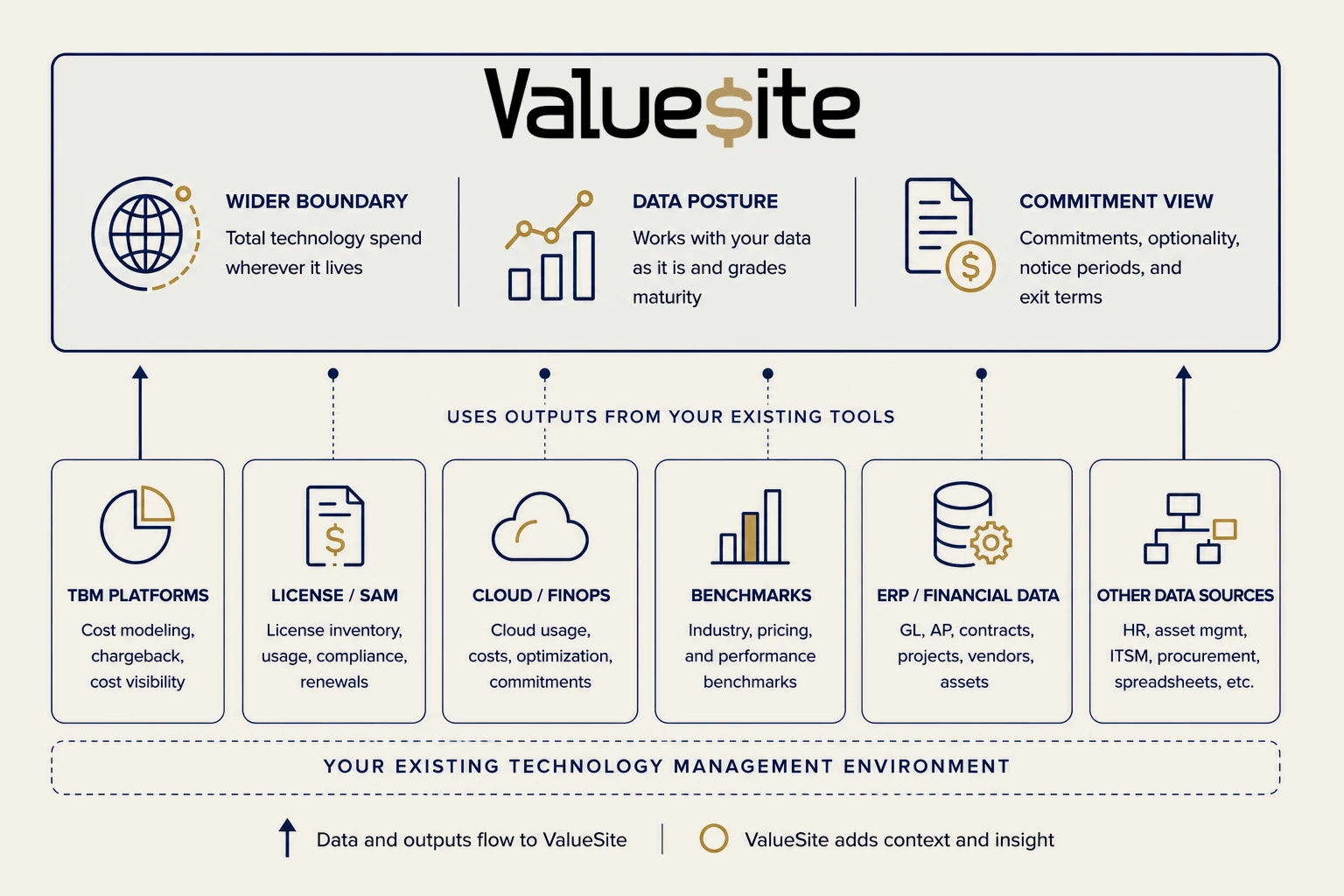
It sits above your stack, not in place of it
ValueSite doesn’t replace the tools you already run; each does real work. It uses their outputs and adds the whole picture: spend, capability, and risk mapped to what the business actually does, a confidence rating on every number, and a view of what you are committed to.
Diligence in days, from data you already have
From a diagnostic of a ~$35M manufacturer being carved out of its parent, working only from data the company already had. The findings were known before close and final pricing, and none required an assumption.
At one mid-market manufacturer, ~12% of technology spend was true overhead. That moves the conversation from cutting IT to what the business would stop selling, making, or serving.
See it against your own estate
The usual start is a 30-minute call, then a fixed-fee diagnostic, built from the data you already have, in days.